Blogging my conversion 2
By Rosie Perera | June 15, 2011 at 4:01 am
Oy boy, it’s happened already. The thought has crossed my mind “Hey, I could play games on this thing! Why don’t I choose a game as a way of learning how downloading new Android apps works?”
Also, I’ve reached my first UI impasse. I am delighted to discover that the Eee Pad can multitask, but I haven’t yet been able to figure out how to close an app. So far everything else has been pretty intuitive, or I’ve been able to discover it with a little bit of experimentation. This one I’m going to have to Google to find out how to do, alas.
One other little thing. I’m so used to being able to do Report Typo in Logos when I’m reading books in it, that I miss that in the Kindle e-book reader Android app.
Topics: Android | No Comments »
Blogging my conversion 1
By Rosie Perera | June 15, 2011 at 12:58 am
I think I might be going through a change in the way I use technology and I want to observe myself going through it and reflect on it as it’s happening, if that’s possible. I’m going to try to balance caution with exploration, which is very difficult.
What is the catalyst for this possible “conversion”? I just bought an Android tablet today — my first touch-enabled device. My main reason for buying it now is to test out the new Logos Android app which is in private beta. But I know already that by using it at all, I’m going to adapt to new ways of interacting with information. I haven’t had a chance before to reflect on such a change as it was happening, hence this new series of blog entries.
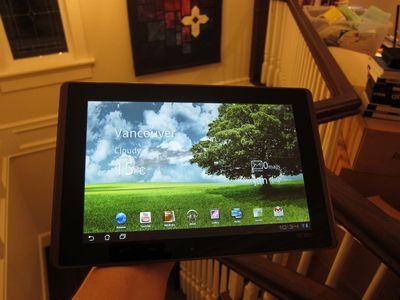
The tablet I bought is an Asus Eee Pad Transformer 10.1-inch 32GB. My initial reactions out of the box are:
1) It comes with absolutely no unneeded junk in the box, unlike every other desktop computer or laptop I’ve bought. Just the Eee Pad itself, the USB power cable and transformer/plug, a warranty card, single page of tips, and a tiny user’s manual. The box itself was only 30 x 21 x 6 cm.
2) The only downside I’ve come across so far is the charging cable is too short (about 90 cm / 3 ft). So you pretty much have to leave it charging unless you want to sit right next to the outlet with it. I did, as I was eager to get started playing with it.
3) It charges pretty quickly, and is a cinch to boot up the first time and go through some initial setup things (WiFi connection needed).
4) I like the feel of it. The back has a nice grip surface so you can hold it up with one palm and read from it. You can rotate the device into portrait or landscape mode and the screen will rotate automatically so everything is right-side-up. (EDIT: I have now discovered that not every app supports this auto-rotate behavior.) If I’m running it with the charging cable plugged in, I like to hold the screen completely upside down so that the cable comes out the top rather than the edge closest to me.
5) As with any of these devices (I played with a Samsung Galaxy Tab, Acer Iconia, and Motorola Xoom in the store before settling on the Asus), fingerprints on the screen are a given. They don’t make problems for visibility, though, at least as long as you’re looking straight at the screen; it’s bright enough to make them invisible. You can see them if you look at an angle. I guess I’ll be wiping this thing regularly just for cleanliness, though. I was told by my friend who helped me pick this out that the touch screens on display models of tablets are about the worst place for germ-spreading, so I washed my hands as soon as I got home from the shopping trip.
First observation about how I’m changing: I was willing to log into this thing with my Google ID, which I’d previously been kind of wary about sharing around for multiple purposes (I had been using it to log in to Blogger and Picasa only thus far, two Google properties). But I felt myself kind of sighing internally and saying to myself “Oh well, here we go, entering a new world. Gotta get with the program.” Of course I knew going into this that Android is a Google platform, and part of the reason I bought the thing was to have access to all the neato Google apps like Google Goggles, so it came as no surprise to me that I was asked to identify myself with my Google ID. But there’s one more step down the privacy slippery slope that I’ve willingly advanced. Interesting. That’s all I’m going to say about it for now.
I crashed it the first day, BTW. It told me I needed to download Adobe Flash Player for something I was doing. I wanted to read the Terms and Agreements before agreeing to download it (silly pedantic me; yes, I’m boldly going where I’ve never gone before, but I’m keeping some of my old safe-computing habits with me, and you’ll have to pry them out of my cold dead hands if you want me to let go of them). But when I tried to click on the link to view the document, I was told I needed Adobe Flash Player, and I got into a vicious cycle. I was stubborn and didn’t give in. At some point, the download app crashed. Not a very good sign. However in the end I was able to read the T&A and downloaded Flash Player and all is well.
A couple of other things I chose (intentionally, thoughtfully) to be more laissez-faire about in terms of privacy were: (a) I accepted the default to let it back up my data, including Wi-Fi passwords (Yikes!) to Google servers; (b) I allowed it to use GPS satellites to determine my location and use that location to improve Google searches. These two things I know a lot of other people are doing with their mobile devices, and they’re not freaking out about it. I am expecting that I will learn to let go of some of my reluctance about storing things in the cloud after using my Android for a while. We shall see, and I’ll be blogging about it.
Topics: Android | No Comments »
RIP Blippy? Yippy!
By Rosie Perera | May 19, 2011 at 7:27 pm
TechCrunch reports “The End Of Blippy As We Know It“. Good riddance, as far as I’m concerned. In spite of the fact that I love the word “Blip” (my cousin and siblings and I have had a running joke about it for decades) I’ve always thought Blippy was a weird concept. It was a social networking site where you would share your credit card transaction details with your friends. My privacy antennae went up big-time on that. Who would want to share that kind of information with friends on a social network? Maybe one or two personal friends, if you need someone to keep you accountable if you’ve been spending too much money. But is there really a huge market for that kind of thing? Social networking thrives on scalability. As the TechCrunch articles points out, “almost nobody wants people to check out their purchases.” The reason why? “Sharing purchases with friends doesn’t solve a problem.” Neil Postman was fond of saying “What is the problem for which [this new technology] is the solution?” and if there wasn’t a problem, he wouldn’t adopt the technology.
Topics: Uncategorized | No Comments »
Twitter and Digital Discipleship
By Rosie Perera | May 19, 2011 at 5:11 am
OK, so I finally caved and got on Twitter (@Rosie_Perera). My excuse was that I had been asked to help monitor tweets during the live streaming broadcast of Krish Kandiah‘s talk at Regent College yesterday evening, “Digital Discipleship: The Opportunities & Challenges of Social Media for the Church” (video of Part 1 [missing a bit of the beginning] and Part 2; lecture notes). But I’ve been flirting with Twitter for some time now, reading people’s tweets, searching for hashtags, keeping TrendsMap up in a browser tab for most of the busiest week of the Egyptian Facebook revolution. I’ve had moments where there was something I felt like tweeting and it seemed not the right thing to put on my Facebook status update, so I had to let the moment go by. As a person who writes and thinks about technology and its effect on interpersonal relationships and spiritual life, it kind of was inevitable that I would eventually get on Twitter to see what it was all about.
I’m not ready to make observations about it yet. It’s only been a few hours. But I’m already starting to see things a bit differently from the inside than I had as an outside observer. I’m trying to maintain my objectivity, but I’m sure it will be hard, as it was after I joined Facebook for pretty much the same reason. I ended up getting sucked in to wasting lots of time on it.
Topics: Uncategorized | 1 Comment »
Is Google making us know too much too soon?
By Rosie Perera | April 27, 2011 at 4:14 am
This is funny, but it’s also so true.
Topics: Uncategorized | No Comments »
Laity Lodge Consultation on Technology (March 10-13, 2011)
By Rosie Perera | April 16, 2011 at 5:02 am
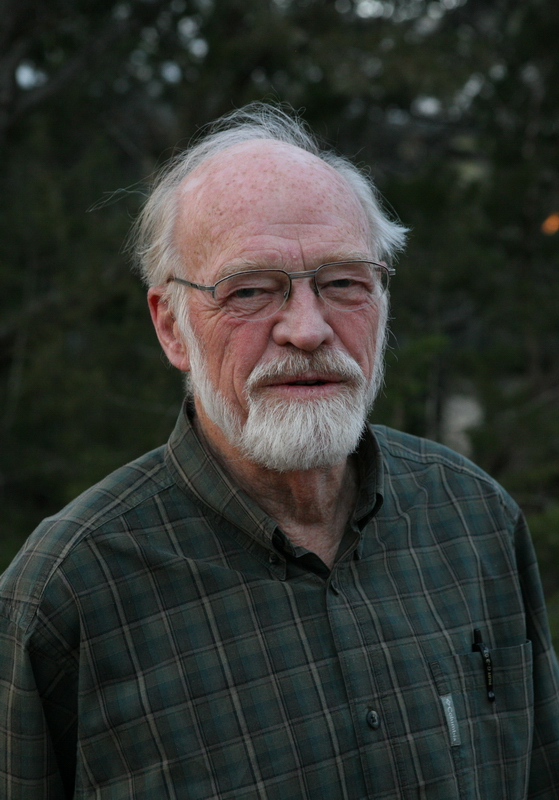 I got a chance to hang out with a bunch of really interesting people engaged with the intersection between faith and technology, at an event last month, the Laity Lodge Consultation on Technology, in the Texas Hill Country. The keynote speakers were Eugene Peterson, whom I studied under at Regent College, and Albert Borgmann, who was one of the authors I wrote my master’s comprehensive paper on.
Many other old friends were there, too. David Gill and Al Erisman, from whom I had taken a summer class at Regent, “Business, Technology and Christian Values,” back in 1996. Wan-Phek How, the Information Systems Director at Regent, with whom I have collaborated. Dave Stearns, an old friend from Microsoft who is now a historian and sociologist of technology and blogs at tech.soul.culture. Steven Purcell, a fellow Regent alum, now director of Laity Lodge, who pulled this whole event together (with the able assistance of Andy Crouch, Arthur Boers, and David Wood). Gisela Kreglinger, assistant professor of theology and spiritual formation at Beeson Divinity School, another Regent alum friend from years ago. Kevin Schut, professor of media studies at TWU, who spoke at the Identity & Technology conference in Edmonton with me a couple of years ago. Loren & Mary Ruth Wilkinson, good friends from Regent and Galiano Island who co-teach a class on Wilderness, Technology & Creation. Eric Jacobsen, pastor and author of Sidewalks in the Kingdom, a friend through his parents-in-law, my former pastor and his wife.
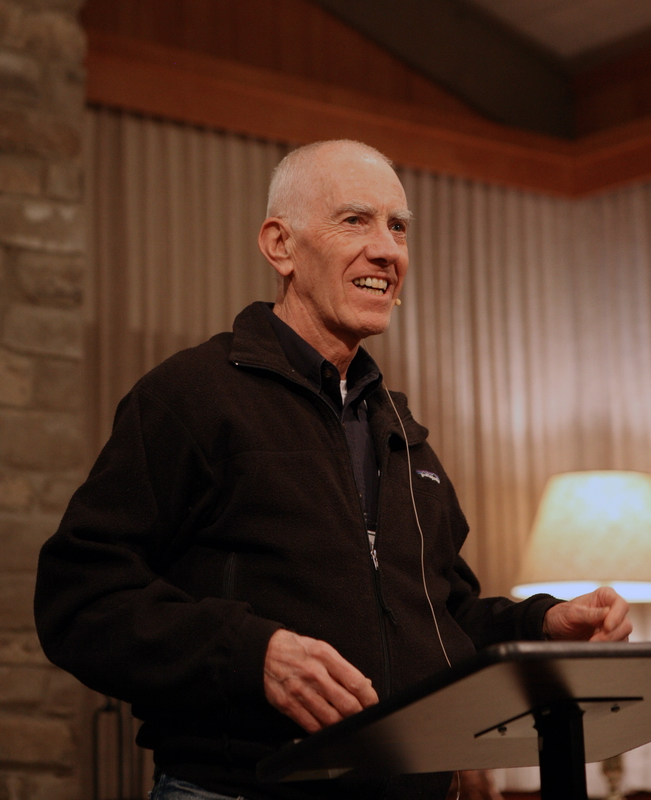 And then there were people I’d heard of and/or known online whom I was looking forward to meeting in person. John Dyer, web developer for Dallas Theological Seminary, and a very thoughtful blogger on faith and technology: Don’t Eat the Fruit. Alissa Wilkinson, a woman of many talents (both techie and literary) who edited some of my columns at Comment Magazine. Peter Harris, co-founder of A Rocha, whom I’d met once before but didn’t really get to know (but he has an amazing memory and recalled our conversation!). Andy Crouch, author of Culture Making and special assistant to the president at Christianity Today, whom I had heard speak at the Transforming Culture symposium in Austin in 2008. Rodney Clapp, author and editorial director at Brazos Press. Lance Mansfield, brainchild behind and webmaster for By/For. Eric Brende, rickshaw driver and author of Better Off: Flipping the Switch on Technology, who with his family lives as much off the grid as possible.
And there were a number of other folks whose presence enriched the weekend, some of whom also had written books (two of which I couldn’t resist buying): Jack Swearengen (Beyond Paradise: Technology and the Kingdom of God), Arthur Boers (The Way Is Made by Walking), Timothy Dalrymple (associate director of content for Patheos), Marcus Goodyear (senior editor of The High Calling), Jason Byassee (research fellow in theology and leadership at Duke Divinity School), husband-and-wife duo Brian Walsh and Sylvia Keesmaat (I’d known of Brian before from his books The Transforming Vision and Truth Is Stranger than It Used to Be, both co-authored with J. Richard Middleton), David Wood (senior minister of Glencoe Union Church), Kenny Benge (rector of St. John’s Anglican Church in Franklin, TN), Mark Purcell (Director of Client Services for online marketing firm Mercent and creator of the website Bird Folio), and many more.
I participated in the Technology Panel on the Friday night. I went bird watching Friday morning with Peter Harris, Kenny Benge, Mark Purcell, and others.
The setting of Laity Lodge is amazing, and it was lovely to be back there again. We ended the weekend with a communion service, followed by brunch (the food there is awesome).

There are some ongoing collaborative endeavors that arose out of this consultation. But the best part was meeting all these men and women who have been thinking about these things for some time. The breadth and depth that we were able to cover in just three days or so was remarkable.
Topics: Uncategorized | No Comments »
Tech companies and political activism
By Rosie Perera | February 12, 2011 at 6:35 pm
What does it mean for a company to “do no evil” (Google’s motto)? Here’s an interesting article on the challenges companies face when their employees get involved in political activism:
Wael Ghonim: A “One-Off” for Silicon Valley?
Topics: Uncategorized | No Comments »
You say you want a Revolution 2.0
By Rosie Perera | February 12, 2011 at 2:07 am
The streets of Cairo and Alexandria and news media around the world are abuzz with stories of what has been unfolding in Egypt over the past 18 days. History is being written. Something unprecedented has happened. A strong dictator who has been in power for 30 years has been ousted. Things are still very uncertain as to the future there, but a new era has surely begun, and there is much elation in the air. I was moved by this celebratory song, “The Sound of Freedom” (Arabic with English subtitles):
Much credit is being given to the leadership of a 30-year-old Egyptian Google executive named Wael Ghonim. He has emerged as a spokesman for a group of people who used social media (Facebook and Twitter, until they were blocked by the government) to help organize the peaceful protests in Tahrir Square (“Freedom Square”).
Hear Ghonim dub this “Revolution 2.0” and tell how “We are getting back our country” in this CNN interview with Ivan Watson:
Here’s another moving interview with Wael Ghonim on Dream TV (three parts; Arabic with English subtitles; if you can’t see the English subtitles, click the “CC” button in the video player to turn them on):Part 1, Part 2, Part 3
I wrote last June about Twitter as a tool for freedom of speech in the midst of the attempted revolution in Iran. It was similarly exciting at the time, but ended up fizzling out when Ahmadinejad’s government clamped down. What is different this time around that allowed it to succeed where the Iranian one failed? This new revolution in Egypt is being called an Internet Revolution, a Twitter Revolution, a Social Media Revolution. But that can’t be the entire story, because the Iranian people had the Internet too (though it was shut down by the government), and the Egyptians blocked Facebook and Twitter and the whole Internet for a while, too. No, surely there are other factors at play. But one cannot deny the role that social media have played.
Here are some of @Ghonim‘s tweets:








Malcolm Gladwell, author of The Tipping Point, wrote an article in The New Yorker in October titled “Small Change: Why the revolution will not be tweeted.”
Wael Ghonim’s response to that, on January 26, was:
Hey @Gladwell, #Jan25 proved you wrong. Revolution can be a #Facebook event that is liked, shared & tweeted. http://nyr.kr/bYKeLq
Some critics have asked how we in the West can think we know what’s going on over there by following English tweets, as surely the real communication is going on in Arabic. True enough. But I imagine that most of the young Internet-savvy people of Egypt are pretty facile with English. No doubt Ghonim’s English tweets are designed for the rest of the world to be able to know what’s going on. But he is not a Western outsider. He tweets plenty in Arabic. And if one is really determined, one can read the Arabic tweets too, using Google Translate (I was pleasantly surprised to see how good a job it does). They’re not much different from what he’s saying in English.
@ElBaradei (a Verified Account, so it’s really him) tweeted just a few minutes ago:

Google Translate tells me that means “Egypt today is free. God bless the people of Egypt.”
Some are skeptical that this revolution really was brought about by social media. Here is a selection of editorials and blog posts:
The ‘Twitter Revolution’ Debate: The Egyptian Test Case
Malcolm Gladwell and the Twitter backlash
Is the role of social media in Egypt being overstated?
Those who are pooh-poohing the role of social media say revolutions happened before the Internet. They point to the American Revolution and the French Revolution, for example. I maintain that while Twitter and Facebook didn’t bring about the Egyptian revolution, they surely were tools that facilitated it happening so quickly and relatively bloodlessly. I say relatively because I know that some people were killed and beaten by Mubarak’s defenders in this struggle. But it was a largely peaceful revolt, and the people did not fight back. They did not need to. They got their wishes in two and a half weeks.
The nay-sayers also point out that such a small percentage (less than 7%) of Egyptians use Facebook that it couldn’t have played a big role. But as Margaret Mead said, “Never doubt that a small group of thoughtful, committed citizens can change the world. Indeed, it is the only thing that ever has.” They also say that the government shut down Facebook and the revolution continued. Yes, but once you start a fire, it’s hard to put it out.
Just as the invention of the printing press didn’t cause the Protestant Reformation (there had to be many other factors at play that made the timing ripe), so social media did not cause the Egyptian revolution. But to use Malcolm Gladwell’s own terminology, perhaps it was the tipping point. The Internet has enabled a generation of Egyptians to get beyond the brainwashing their own government was using to try to keep them in line. And it facilitated the communications necessary for a popular uprising. Wael Ghonim said: “If you want to liberate a society, just give them the Internet.” The converse is also true: If you want to keep a society in bondage, severely restrict their access to the Internet. Can you say “North Korea”?
Here’s a clever snippet seen on CNN:

While all of this is fascinating from a political, historical, sociological, and technological perspective, and I am rooting for the people of Egypt, as a Christian I do not believe that “people power” is the ultimate solution for all evil, nor is technology our savior. When Jesus came, many mistakenly thought he had come to overthrow the Roman oppressors of the Jews. But that isn’t what his kingdom is about. Jesus came to set captives free in a spiritual sense, to release those who are in bondage to sin and evil. But part of God’s kingdom coming “on earth as it is in heaven” involves healing (both physical and spiritual, of both individuals and peoples), reconciliation and justice. One of the most hopeful images to come out of the past couple of weeks is this one of Christians forming a ring of protection around Muslims as they prayed:
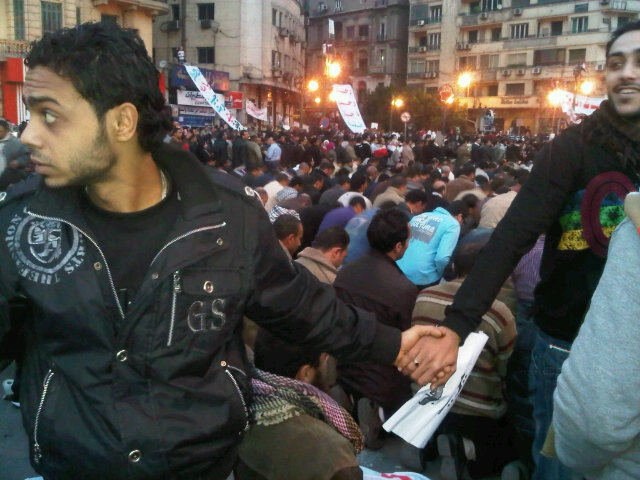
I’m going to be fascinated to watch how things turn out over the coming days and weeks. I pray that “it’s gonna be all right…”
EDIT: This post got a visitor from Iran within its first few hours of being birthed. Intriguing. I wonder whether it’s the government trying to look for stuff to block their people from seeing or whether it’s a freedom seeker looking for information and inspiration. (Click to enlarge.)

Topics: Uncategorized | No Comments »
Is Facebook making us sad?
By Rosie Perera | February 3, 2011 at 6:15 pm
Slate recently published an article by Libby Copeland entitled “Anti-Social Network: By helping other people look happy, Facebook is making us sad.”
I am not so sure. In my experience, there is a lot of variability among people as to how honest they will be on Facebook about how their life is really going. Plenty of my friends post status updates when they are unhappy about something or just generally having a crummy day. It is possibly a self-selecting phenomenon. I’m more likely to be friends in real life with people who are honest about their emotions, and those types of people tend to be more honest online as well. The study reported in that article did not look at Facebook explicitly, and it dealt exclusively with college students, who might be at a stage in life where it’s more important to impress your online friends with how much fun you’re having than to be real with them. So I’d take the sweeping conclusions the author draws with a grain of salt. Nonetheless I was glad for her recommendation of Sherry Turkle’s new book Alone Together: Why We Expect More from Technology and Less from Each Other. I have great respect for her work and have added this to my list of books I want to read.
Topics: Uncategorized | No Comments »
Be careful what you ‘like’ on Facebook
By Rosie Perera | January 27, 2011 at 8:42 pm
CNN did a story today about a new development on Facebook. They are now beginning to use comments you make about companies in your Facebook chatter with friends as fodder for advertisements, referencing you (with your photo) as the one who recommended the company. It’s yet another way of monetizing friendship.
Topics: Uncategorized | No Comments »
« Previous Entries Next Entries »