Disturbing new technology
By Rosie Perera | February 3, 2018 at 12:57 am
I’d seen “faceswapped” photos before, and have done my own photoshopping of images to put faces of people I know into famous paintings. But I first became aware of the technology that lets people to edit video footage, replacing heads in the video with other people’s heads, through this impressive montage of Trump and his cronies being arrested by the FBI that was circulating around social media a while back. It is truly impressive, though it’s quite obvious that it’s a fake. And because it comported with my own political leanings, I laughed at it, passed it along, and thought no further about it.
Then tonight I came across this worrisome article and learn a new word (“deepfakes”) and about a new trend that could be used for nefarious purposes.
Deepfakes Porn Has Serious Consequences (BBC)
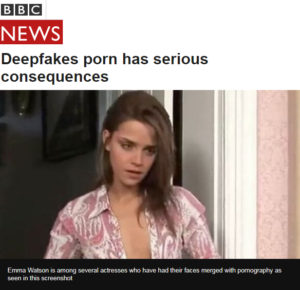
Of course I had laughed off the Trump arrest video above (though his supporters may think there was a nefarious purpose underlying it). But the technology will only get better, to the point where it’s seamless and the fakeness can’t be easily detected. And things like that could be done to denigrate or even ruin the lives of people I trust. It could severely undermine our ability to detect what real and what is fake, which is already being messed with. Makes the old VHS ad campaign slogan “Is it live, or is it Memorex?” (often misremembered as “Is it real, or is it Memorex?”) sound quaint. There will soon come a time when we literally can’t believe our eyes anymore. I shudder to think of it.
Topics: Uncategorized | No Comments »
Platonism of Microsoft Word?
By Rosie Perera | October 21, 2014 at 7:07 pm
I just read an interesting article in the New York Review of Books, “Escape from Microsoft Word” by Edward Mendelson. The author claims that Microsoft Word is built on a Platonic model with the “ideal” of a perfect intangible “document” of which books, letters, memos, and essays are mere imperfect representations. He struggles with what he thinks are the incomprehensible rules of how Word handles formatting, which he found more sensible in WordPerfect before being forced to switch. In Word, you turn on formatting attributes for an entire unit of the text (paragraph, section, whole document) and smaller units (characters, paragraphs, sections) inherit the formatting from the larger unit. You can apply exceptions to the formatting of the larger unit as “direct formatting.” When you apply a style to some text that already has some direct formatting within it, Word has a non-obvious way of deciding whether to keep the direct formatting or cause it to be overridden by the formatting of the style. It turns out the rule is that when more than 50 percent of the text has some “direct formatting” it is overridden by the style, but if less than that is direct formatted then it is not overridden.
I was probably aware of this odd 50-percent rule when I worked on the Word development team, but I’d long since forgotten it and had to experiment a bit just now to convince myself that Mr. Mendelson was right. I can’t remember any of the discussions of why we decided to do it the way we did, but it is indeed non-intuitive and arbitrary. Applying a style should behave consistently so that users don’t have to guess what to expect: either it should always override any direct formatting, or it should never do so. Better yet, it should be smart about reversing emphasis (italics) in direct formatting when you apply a style to a containing unit. For example, if I had a heading in my paper that read “Prayer in George Herbert’s The Temple” and then I decided to make all my headings italic and applied a heading style with italic in it to that paragraph, I would want “The Temple” to be turned into non-italic, according to the rule in Turabian.
In any event, I enjoyed Mendelson’s likening of Word to Platonism. Very apt. I still think it works fine if you understand it, if you didn’t come from the WordPerfect world which was based on how typewriters worked.
The sentence I liked best in the article was “The original design of Microsoft Word, in the early 1980s, was a work of clarifying genius.” 🙂
Topics: Uncategorized | No Comments »
Over-the-top technology?
By Rosie Perera | September 24, 2014 at 11:53 am
When is new technology excessive? Who would pay $219 for a “smart” toothbrush that reminds them how to brush their teeth? Remember to brush every section of your mouth (who doesn’t do that anyway without reminders), and brush for a full two minutes. And you have to hold your phone in your other hand the whole time to watch your progress report. No thanks. I suppose some people will think it’s cool and try it for the novelty, but I doubt it will be a big seller.
Topics: Uncategorized | No Comments »
New User Registration
By Rosie Perera | March 12, 2014 at 6:33 pm
I’ve had to temporarily disable new user registration (which is only required if you want to post comments), as I was getting flooded with bot registrations. Managing blog spam these days has become a royal pain in the neck. Thus new users will not be able to register and comment until I get around to choosing and installing a solution that will prevent bots from registering. Sorry for the inconvenience. If you would like to contact me about becoming a registered user so you can comment sooner, find my email address (encoded so only live humans can read it) on the About page.
Topics: Uncategorized | No Comments »
I’m baaack!
By Rosie Perera | March 3, 2014 at 1:17 am
I had let this blog get broken because I postponed upgrading to the latest version of WordPress for too long, and so it was lying dormant and unusable. Apologies to the many who pointed this out to me who liked to read my thoughts on faith and technology.
Well, the blog back up and running again. Still one kink to iron out (the Search box works only from the Home page, not from anywhere else on the site; but you can always click “Home” to get back there and search from there). Will try to figure that out soon.
Topics: Uncategorized | No Comments »
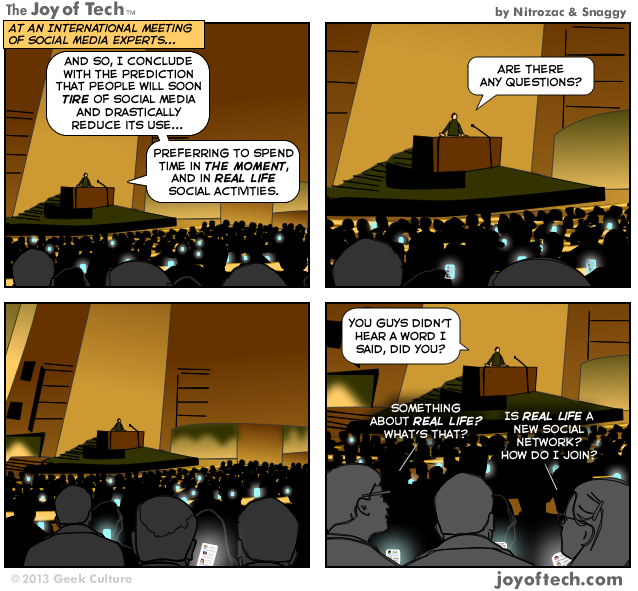
Social media vs. real life
By Rosie Perera | January 21, 2013 at 2:32 am
Topics: Uncategorized | No Comments »
The Social Meaning of Technology
By Rosie Perera | January 8, 2013 at 3:13 am
Good post from my friend Dave Stearns over at tech.soul.culture on how “the social meaning of a new technology is dynamically worked out over time”:
The Social Meaning of Technology
Topics: Uncategorized | No Comments »
Beyond “Netiquette”
By Rosie Perera | December 13, 2012 at 10:30 pm
I witnessed a very discouraging thread today on a forum frequented by Christians. It is a very active forum with almost 100,000 users and nearly half a million posts. The forum is meant for asking and answering questions about Bible software, and theological debates are forbidden by the forum guidelines. Sadly, with many people coming from vastly different theological positions, it is inevitable that things flare up from time to time. But in this case the hurt came from common online behavior that had nothing to do with faith.
A newbie user who had never posted before asked a simple question about how to find something in the software. She posted in all caps, as many newbie online users do. Another user posted right after her, ignoring the content of her question: “MIGHT I SUGGEST IN ALL HUMILITY AND AS A BROTHER IN CHRIST THAT YOU FIRST FIND THE CAPSLOCK KEY. all caps is hard on the eyes, and in internet culture is akin to yelling. I’m sure you weren’t yelling at us as your first post (intentionally). Any how, welcome!”
Needless to say, she did not feel welcomed, and a flurry of other posts from others added insult to injury, including the initial poster directing the newbie to http://www.networketiquette.net to learn “how not to be rude on the internet.” She ended up signing off with: “This will be my last posting, I appreciate the people who truly have acted like CHRIST, and I am truly sorry if I have offended anyone. I do find it incredible, that all I asked for from a community of ‘Christians,’ was some advice and received such a negative response. My idea of Christianity is to be as courteous on the web, as you are in person. I teach a Bible Study and my group tonight were as shocked as I was earlier today. This is why I have never opened myself up to forums on the web, and I usually do not make the same mistake twice. JESUS said, “Do not cast your pearls before swine, lest they turn and rend you.” I expect maltreatment from the world, but not from a forum geared for ‘Christians.’ “
Perhaps the initial responder was really trying to be “helpful” in educating her to understand internet culture. But the way he expressed it was awful. YELLING RIGHT BACK AT HER. And the timing of it was even worse, like a slap in the face.
I think we need some remedial training in “etiquette among Christians online” which goes above and beyond the usual netiquette sorts of sites. Yes, it’s true that CAPS LOCK is a convention that means yelling, but the only time it’s ever referred to that way is by people chiding others who didn’t know that. Since all who are experienced Internet users can recognize a newbie making that mistake, perhaps we should just overlook it and not assume they are yelling. Telling them off for it is more offensive than someone actually intentionally yelling with ALL CAPS would be.
As Christians, we should be above calling people out for misunderstanding what everyone else who has been on the ‘net for years knows well. It isn’t a helpful habit and does not bond people together in Christian community. There could be a neutral place for general instruction about such matters as the caps lock convention, but certainly not as an immediate response to somebody just asking an innocent question.
It makes me weep that we as the body of Christ do not know how to love each other through the medium of technology. It probably carries over from not knowing how to love each other very well in person either, but technology brings its own unique challenges.
But to brighten my day that was otherwise sullied by that experience, someone else told me the title of the person who does their church’s website work. He’s the “web minister” as opposed to “webmaster” — I love that! One can never really “master” the web anyway; it tends to master us. But we can minister to others on it and through it. And let us all strive to learn how to minister to newbies, not by “educating” them in “netiquette” but by truly loving them as Christ would.
Topics: Uncategorized | No Comments »
Albert Einstein quote
By Rosie Perera | October 31, 2012 at 1:10 pm
“I fear the day when the technology overlaps with our humanity. The world will only have a generation of idiots.”
And indeed, I’m already becoming part of that generation, because I can’t find the source of that quote. It’s all over the Internet, attributed to him, but no information about where or when he said it. And as well all know, “the trouble with quotes found on the Internet is it’s difficult to confirm their authenticity” (Abraham Lincoln).
Topics: Uncategorized | No Comments »
Apple picking has always come at a great cost
By Rosie Perera | October 11, 2012 at 1:11 am
Marshall “Soulful” Jones critiques our digital culture through a slam poetry performance of his piece “Touchscreen” at TEDxMontreal. He also would make a pretty good mechanical man living statue.
H/T Leif Hansen for the video link.
Topics: Uncategorized | No Comments »
« Previous Entries