Giving up Facebook for Lent
By Rosie Perera | February 22, 2012 at 1:04 am
I’m doing it again this year. Kind of a last minute decision as I witnessed at least two or three of my Facebook friends signing off for now, until Easter. I’d been planning to just give up procrastination but one of my biggest ways of procrastinating is checking Facebook (“just one quick little check” and then I get sucked in), so I think that really needs to go too.
If you’re planning on giving up Facebook for Lent: I’ve done it a couple of years in the past, and it helps if you actually deactivate your account. Then the temptation to take one little peek can be fought off more easily. When you reactivate your account, your friend network and all your settings are still intact; you’ve just missed out on whatever junk would have come your way for these next 40 days. To deactivate, go to Account Settings, click Security in the left sidebar, and then click “Deactivate your account.” Hasta la vista, baby!
Topics: Tech Sabbath | No Comments »
Alex Pang on Contemplative Computing
By Rosie Perera | February 10, 2012 at 11:59 pm
Futurist Alex Pang talks about “contemplative computing” on an episode called “Worship 2.0” on Encounter (ABC National Radio, Australia).
Alex is at work on a book about Contemplative Computing which he interviewed me for. I’m looking forward to it.
Topics: Uncategorized | No Comments »
An awesome advance in medical technology
By Rosie Perera | February 9, 2012 at 7:02 pm
I haven’t had time to keep up with blogging about all the tech news lately. It has been flying at me fast and furious. But I just had to give you faithful blog readers something new to chew on, so to speak.
Another First For 3D Printing – Woman Receives Jaw Implant
I first saw 3D printing in action at Maker Faire in Vancouver last June. It’s pretty cool. But now here’s the first time it’s been applied to replacement body parts. You might view this as a creepy Frankenstein-like development, or you could rejoice in the amazing creativity of scientists and engineers. I choose the latter.
Topics: Uncategorized | No Comments »
“It’s okay, the Internet will be just fine without you”
By Rosie Perera | November 21, 2011 at 7:32 pm
Here’s an ad for the Dodge Journey which plays on our sense of online overload and our desire to experience more of the “world wide world.” It starts off: “People don’t make a list of websites they want to see before they die.”
Thanks to Michael Sacacas for bringing it to my attention, and for pointing out that “The real issue, after all, may not be whether the Internet will be just fine without us, but whether we will be just fine without the Internet.”
Topics: Uncategorized | No Comments »
Insights from Orthodox spirituality on technology
By Rosie Perera | November 20, 2011 at 1:17 am
Yesterday I wrote about mindfulness on the computer and a new clock app I’d discovered to help me with that. Today I was introduced to the word nepsis, the hesychastic practice of perpetually guarding and watching over the heart, lest the passions (“the sinful inclinations, movements, or energies within a human”) rule over us and distract us from the contemplative experience. (1) I realized that that’s precisely what I’m trying to do with being more mindful at the computer. I began to wonder whether anyone has written anything linking Orthodox spirituality, hesychia, nepsis, with the distractions of technology.
My wondering was rewarded by this excerpt from Spiritual Instruction and Discourses, Vol I: The Authentic Seal by Archimandrite Aimilianos: “Orthodox Spirituality and the Technological Revolution”
He argues that there isn’t anything essentially different about today’s technology, in its effect on our spiritual life, than there ever has been. Technology per se is not the problem. Rather it is the “absence of accountability in the way in which technology is administered and exploited.” He reviews the historical development of technology as “the fruit of the reasoning and intellect of Man, who was formed in the image of God.” He looks to the monastic tradition to find appropriate models for how to keep technology in check. He points out that “the Church and monasticism are not hostilely disposed towards technological progress. On the contrary, monks over the centuries have proved to be powerful agents of scientific and technical invention.” Finally he explains that Basil the Great outlined two criteria for the use of technology:
1) restraint – Technology is “necessary in itself to life and provides many facilities.” It is not harmful to peace and tranquility, unity, and undistracted devotion to the Lord, provided it is used with “moderation and simplicity.”
2) spiritual vigilance – Spiritual vigilance, taking time to “pray, to concentrate and cast off the cares of the world” helps people “stave off the disastrous effects of the technological society” in which they become “consumers and slaves to images and information, which fill their lives.”
If we can use technology that helps us practice more restraint and spiritual vigilance, I’m all for it. I do think ClockSmith Lite which I wrote about yesterday, and Timetrek, which I’ve also started using, will help me in that direction. Timetrek is a free personal time clock app. You can punch in and punch out when you start/end work on any project, so it can track the time you spend on each project. I’m using it to track how much time I’m spending in total on the computer each day. Today I’m at just over four and a half hours, which is less than normal, and I have ClockSmith Lite and Timetrek to thank. Not only am I pausing to pray a short breath prayer each quarter of an hour, I’m also taking a complete break away from the computer after every hour of accumulated time. And once I begin a break away from the screen, the draw to come back is less, so I can get some exercise, do some contemplation, read, or do something else for a while. Normally, when I’m glued to the screen, I have a really hard time weaving any of those other things into my day. It’s only been one day of these new practices so far, but I am already quite encouraged.
(1) Edmund J. Rybarczyk, Beyond Salvation: Eastern Orthodoxy and Classical Pentecostalism on Becoming Like Christ, Paternoster Theological Monographs (Eugene, OR: Wipf and Stock Publishers, 2004), 39.
Topics: Uncategorized | 2 Comments »
Mindfulness on the computer – a helpful app
By Rosie Perera | November 18, 2011 at 3:37 am
When I was growing up, my parents had a chiming clock that would sound the Westminster quarters throughout the day. It was always a comforting reminder of the passage of time. When I’m on the computer, hours and hours can go by without my being aware of my own body and physical surroundings, let alone the passage of time. I have been working on developing more mindfulness so that I can avoid getting so deeply sucked into cyberspace for such long stretches of time.
I recently came across the idea of using a clock app that plays a bell or other WAV file sound on the hour or at customizable intervals, to remind yourself to take a break, or to simply pause and be mindful for a moment. I explored a few such apps and found what I think is the ideal one. ClockSmith Lite is exceedingly simple but elegant. It plays the Westminster chimes and tolls the hour. You can set it to play quarterly, on the half hour, or just on the hour. And you can set the volume and whether to have it run at Windows startup. That’s it. That’s all that’s needed. I love it!
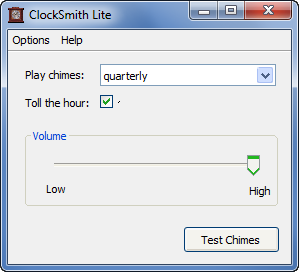
I had tried the sorts of apps that lock you out of the computer, or at least the Internet, for stretches of time, but I always found them too draconian and I would eventually disable them, which defeats the purpose. This is so gentle and beautiful, brings back fond memories of home and family, and it’s in harmony with my desire to be able to integrate my spiritual awareness with my use of technology, as opposed to always having to get completely away from the technology in order to have a healthy spiritual life. There are surely times to get away from the computer and the Internet for a tech Sabbath, but this is the first practical solution I’ve come across for how to keep that spiritual awareness going when I come back to the computer from time away.
Now, whenever the clock chimes ring every quarter of an hour, I pause, close my eyes, put my hands together in a prayer posture up to my face, breathe deeply, and contemplate for a moment. Then I open my eyes and look up at the system clock to notice what time it is. I’m going to be less likely to abuse my body and stay up until all hours of the night when I am reminded every 15 minutes of how late it is getting to be. This post is an odd exception, as I’m writing this at 2:30am. But I only just discovered the app tonight. Now begins the next step in my journey to more mindfulness at the computer. Good night!
Topics: Uncategorized | 1 Comment »
Cool tech toy: spherical drone
By Rosie Perera | October 25, 2011 at 3:50 am
Man, I want one! Just to play with if nothing else. But I can imagine a practical civilian use for it: attach a webcam to it and send it off to check on things for you: e.g., go look at the front door of some store that has no website to check what hours it’s open, see a better picture of something that Google Street View doesn’t show clearly enough, get in free to watch a baseball game from a distance, etc.
There’s lots of other cool tech invention news where that came from: DigInfo.tv. For example, there is a squeezable balloon input device, which I could see being developed further to help handicapped people who can’t speak and don’t have usable hands or feet give instructions to their computers. That application wasn’t mentioned in the accompanying story.
I get really excited when I see new amazing technological achievements. The initial excitement needs to lead to thoughtful analysis, though. Are we doing this merely because we can do it, or is it a net benefit to humankind? However, the excitement helps motivate innovation, and sometimes the “what’s it good for?” and “what’s it bad for?” questions can’t even be answered until the thing is created.
Topics: Uncategorized | No Comments »
Albert Borgmann to give Laing Lectures at Regent
By Rosie Perera | October 18, 2011 at 1:04 am
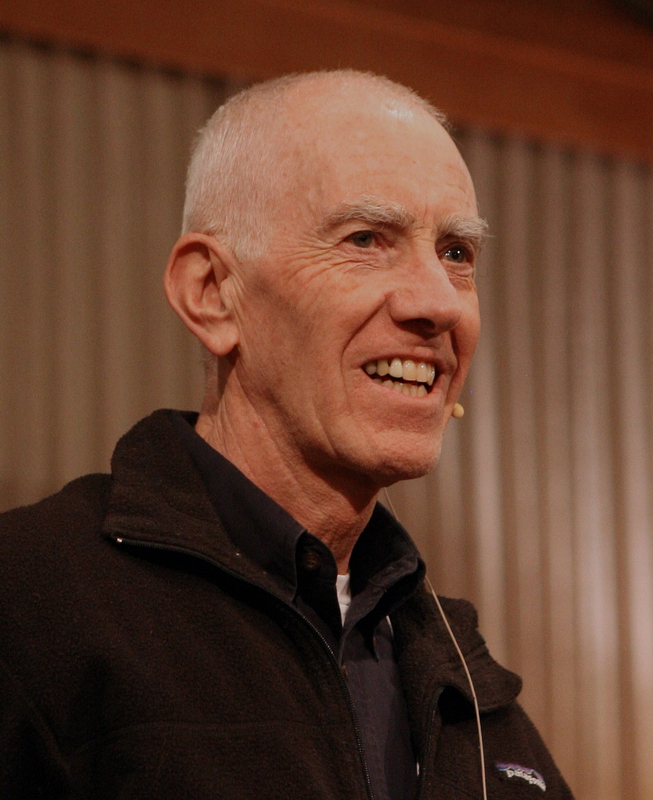 Albert Borgmann, a philosopher of technology from University of Montana, is coming to Vancouver to deliver the Laing Lectures at Regent College next week (Oct 19 & 20, “The Lure of Technology: Understanding and Reclaiming the World”), so I thought I’d devote a couple of posts to him and his work.
I met Dr. Borgmann at the Laity Lodge Consultation on Technology in March. Prior to that, I had studied his major work Technology and the Character of Contemporary Life (University of Chicago Press, 1984) for my master’s comps at Regent. I must say he is easier to understand in person than in writing, but maybe I found him so because I’d already absorbed his main ideas through much study. Anyway, he is a very congenial person and I am looking forward to seeing him again, though the more study and thinking I’ve done since embracing his ideas, the more unsure I am that I agree with him completely. He has become quite influential in the circles of philosophical and Christian thinking about technology, so I think it’s important to understand his contributions to the field, and perhaps push back a bit.
Borgmann is a Christian, though most of his writing does not assume that as his starting point. His only book aimed specifically at a Christian audience is Power Failure: Christianity in the Culture of Technology (Brazos, 2003), a collection of essays previously published, revised and arranged in some sort of cohesive order for this book. Though ostensibly written for the educated lay (as in non-philosophically trained) reader, it is, I confess, almost as hard to wade through as Technology and the Character of Contemporary Life (TCCL). Since he is pretty inaccessible to the general public, I present here my summary explanation of TCCL (edited down slightly from what I included in my comps paper). In a later post I will provide a critique.
Borgmann proposes that we think about technology in terms of what he calls the device paradigm. A device is something that procures for us a commodity (goods or services) without demanding any skill or attention of us. For example, a stereo provides the commodity of music without our having to know how it works, as opposed to playing a musical instrument which requires knowledge, practice and effort. The more sophisticated the device, the more incomprehensible and concealed from our view is its mechanism.
The more technology advances, the less aware we are of its background (the mechanics of how it works and the political and economic conditions under which it operates) when we consume its commodities. Commodities become disconnected from their contexts. Borgmann gives the example of TV dinners which are prepared instantly and eaten in a hurry without any depth; the fellowship of kitchen and table are missing, which subtracts from the meaning of the meal.
The promise of technology – that it would provide freedom from hardship, disease, and toil – has not materialized unambiguously. New freedoms are offset by increased burdens elsewhere. The benefits of technology are unjustly distributed. Perhaps the promise is too vague and not worth keeping. It results in the pursuit of “frivolous comfort.” (39) What was meant to give liberation and enrichment yields instead disengagement, distraction, and loneliness. (76)
Another problem is disorientation. In pretechnological society, one oriented oneself by reference to the sun. Today we have nothing around which to orient ourselves. We have lost what Borgmann calls focal things and practices. A focal practice is an activity which “can center and illuminate our lives…a regular and skillful engagement of body and mind.” (4) Playing a musical instrument is a prime example. A focal thing is something which is used in a focal practice, such as a violin. The promise of technology causes us to trade focal things for commodities and engagement in focal practices for diversion. We are left feeling a sense of loss and betrayal of the traditions to which we are indebted.
The device paradigm leaves a dichotomy between work and leisure and diminishes happiness in both. Technology has reduced work to degrading labor. While work bestows dignity, labor is drudgery. Increased technological affluence has brought with it a decline in reported happiness.
There was and remains an ideal of a life of leisure and the pursuit of excellence, which includes world citizenship, intelligence, physical valor, musical and artistic talent, and charity. This used to be the privilege of the elite, but advances in technology were supposed to make it available to the masses. But to whatever extent technology has provided us with more leisure time, we have not been using it to pursue excellence.
Since technology tends to be invisible under the device paradigm, and we live in an advanced industrial country, we are “implicated in technology … profoundly and extensively.” (105)
Borgmann wants to find a way for focal things to thrive in the midst of a technological context. Thus he proposes a reform of technology which “is neither the modification nor the rejection of the technological paradigm but the recognition and restraint of the pattern of technology so as to give focal concerns a central place in our lives.” (211) Technology itself is not a focal practice. Indeed, it has “a debilitating tendency to scatter our attention and to clutter our surroundings.” (208) “If we are to challenge the rule of technology, we can do so only through the practice of engagement.” (207) This suggests a return to focal things and practices in our lives today. Borgmann highlights “running and the culture of the table” as two such practices capable of providing a centering and orienting focus in the midst of a technological culture. A focal practice can also be a sacred one, a reenactment of some key event, such as the eucharistic meal.

UPDATE: Arthur Boers, whom I also met at the Laity Lodge Consultation on Technology, has just written a book which is a pastoral appreciation and application of Borgmann’s ideas. It’s called Living into Focus: Choosing What Matters in an Age of Distractions. It’s available now for pre-order through Brazos Press, Amazon, and other book sellers.
Topics: Uncategorized | No Comments »
Blood in the Mobile
By Rosie Perera | October 14, 2011 at 4:35 am
I saw a challenging documentary yesterday as part of VIFF (Vancouver International Film Festival). Blood in the Mobile is the story of Danish director Frank Piasecki Poulsen’s quest to find out the truth behind the so-called “blood minerals” mined in the Democratic Republic of Congo. He had heard that the mining of coltan (columbite–tantalite), used in the manufacture of mobile phones and other electronic devices, is fueling the war in the Congo. He wanted to find out whether this was true, whether his mobile phone company (Nokia) was knowingly using “blood minerals,” and whether they were doing anything to change it.
He starts out by trying to get in touch with someone at Nokia who might know something about this, but is given the run around for a couple of weeks. So he finally decides to go down to the Congo and find out for himself. Putting himself at great personal risk, pushing through all kinds of red tape at various levels of government and military, and paying bribes, he finally manages to talk with some people who know what is going on and are willing to tell him about it, though very few will talk on camera, and they tell him to be very careful as “anything can happen.” He is eventually able to visit one of the mines, at Bisie, guided by a 16-year-old boy who used to work there. Frank confirms his suspicions and finds out things are even worse than he’d heard. The militias are indeed financing their war on the backs of the village people (including many children) who are working in the dangerous mines. More than 5 million have died in the conflict over the past 15 years, and 300,000 women have been raped.
Frank returns to Nokia armed with his new knowledge. Though he does get to meet with people who admit Nokia is aware of the problem this time, the impression he leaves with is that they can’t — or rather won’t — do much to change it because “it’s complicated” and ultimately it would cut into their profits. He also talks to activists who are working to make consumers aware of the issues in the Congo and pressure companies to make their products with “conflict-free minerals.”
Here’s an article with some more information about the history of the problem: Coltan and conflict in the DRC
And here’s a video: In Focus: Congo’s Bloody Coltan
As a follow-up, I found this hopeful article posted in Forbes just a couple of days ago which appears to indicate that some change is coming: Anticipating New SEC Rules, Tech Companies Shift To Conflict-Free Metals
Of course all situations like this are complex, and if companies pull out of Congo and get their coltan elsewhere and the mining business collapses, there go the livelihoods of so many thousands of laborers.
What are we in the West in our comfortable lives with our addictions to our BlackBerrys and iPhones to do with this knowledge? Well, perhaps not upgrade to the latest greatest right away if you’ve already got a cell phone. It is of course the demand for these products that drives the price of the minerals used in them up, which is what makes access to them worth fighting over. Here is a case where understanding more about the processes used in producing our tech tools (instead of keeping them hidden behind the opaque “device paradigm” as Albert Borgmann calls it) can help us to be more responsible consumers. This is what is happening all over the place in the food realm, so why not expand that to our digital technologies?
Topics: Uncategorized | No Comments »
Inventor of the e-book dies
By Rosie Perera | September 13, 2011 at 6:17 pm
Michael S. Hart, the founder of Project Gutenberg and inventor of electronic books, died on September 6, 2011. He did something great for the world, and I’m very grateful.
Topics: Uncategorized | No Comments »
« Previous Entries Next Entries »